

UrbanSpark Logistics is a B2B distributor of premium e-bike components based in Munich. On paper this company looked healthy to us: one central warehouse, 47 dealer partners across southern Germany, 38 active products, eight tier-1 suppliers. But like many mid-sized distributors, it was losing money in places nobody was checking.
The annual logistics bill was €482,259, seen simply as “the cost of doing business.” In our experience, that is exactly where the biggest opportunities hide.
The work started the way good supply chain work should: not with a tool, but with data. A full baseline covered the three places logistics costs come from: transport, inventory, and stockouts, and it showed real problems. Route distances had been recorded as one-way trips instead of round trips, understating the true cost. Safety stock and reorder points had never been checked against demand variability: unpredictable items were under-protected, stable ones overstocked, and reorder quantities seemed to follow habit, not economic logic.
Then came the redesign, in three connected steps.
First, products were segmented with an ABC-XYZ analysis, by revenue and demand variability: a cheap product with unstable demand can cause more damage than an expensive, predictable one. Second, delivery routes were re-optimized: the Munich routes alone dropped from 320 combined kilometers to under 82, just by sequencing stops better and respecting the van’s weight limit. Third, the inventory policy was rebuilt product by product: safety stock, reorder points, and economic order quantities, with higher service levels for products that hurt most when they run out.
Finally, a Monte Carlo simulation tested the new policy against the old one: two thousand simulated years for every product. The results were clear.
Total annual logistics cost dropped from €482,259 to €378,263: a saving of about €104,000 a year, a 21.6% reduction, mostly from better routing. Stockouts were projected to fall by roughly 74%, from 33 a year to around 9. Inventory was not simply reduced, but redistributed: more protection where demand is unstable, less where it is predictable.
But here is the twist. UrbanSpark Logistics does not exist!
The company is fictional. Every customer, order, and euro of cost was created with AI: a realistic but invented case, with the same messy, imperfect data found in real life. There was no client, no project, no invoice.
What is real is the analysis: the ABC-XYZ logic, the routing constraints, the safety stock formulas, the service levels, the reading of results, all done by a second-year Logistics Management student at the university in Darmstadt, Germany, applying what he is learning in class to a problem that behaves like a real one. That student’s name is Rafael. He is the son of Leandro Oliveira, founder of WeDigit Consulting.
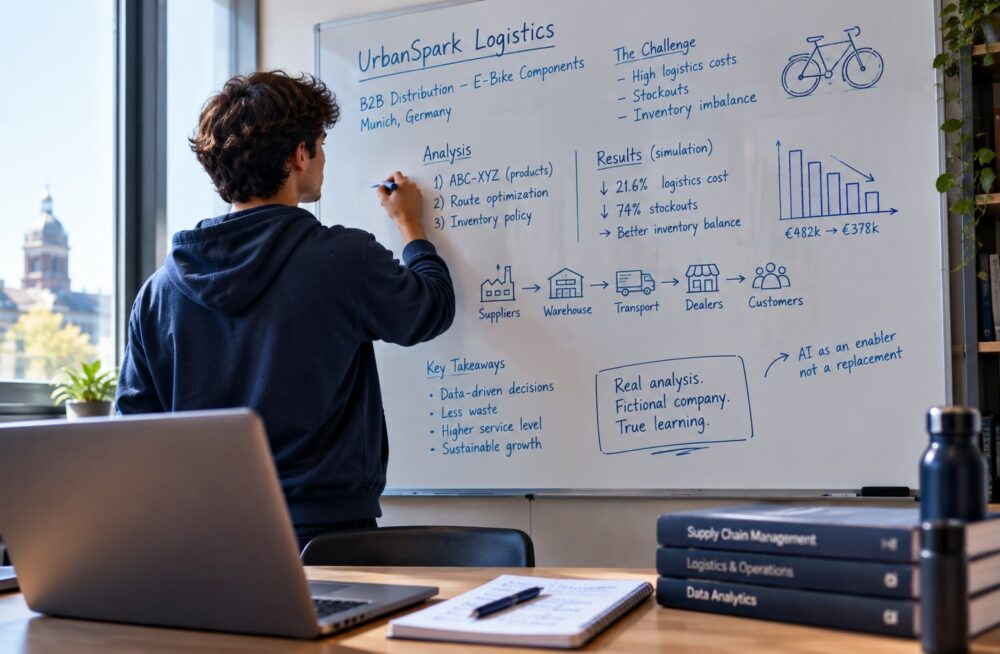
He wanted to practice before anyone paid him for this work, so he used AI to build a company, then did the consulting himself: the thinking, the method, the trade-offs, the recommendations.
There is a debate happening now in almost every company and career about whether to use AI and how much to use it, much of it driven by fear: Will it replace me? Is it cheating? Should I avoid it? I understand the concern, but watching this project come together showed me the real question is not whether to use these tools, but how.
Used badly, AI is a shortcut that skips the learning. Used well, it is the opposite: it gave a twenty-one-year-old a real company to learn from, then let the real skill, supply chain reasoning, be applied, tested, and improved. The technology did not do the work. It created the conditions for the work to happen, exactly the role I have argued that technology should play, throughout my career: an enabler, not the differentiator.
So while some are still asking whether AI belongs in their learning and careers, others are already using it the right way: to learn faster, practice safely, build real experience, and become more capable, not less.
The full report, with the fictional scenario, the complete methodology, the assumptions, and the detailed results, is available here.
And if you want to follow the person who actually did the work, you can find Rafael here:
https://www.linkedin.com/in/rafael-oliveira-logistics/
If you are a leader still unsure about AI, here is my honest question: are you using it to skip the work, or to make more of it possible?